
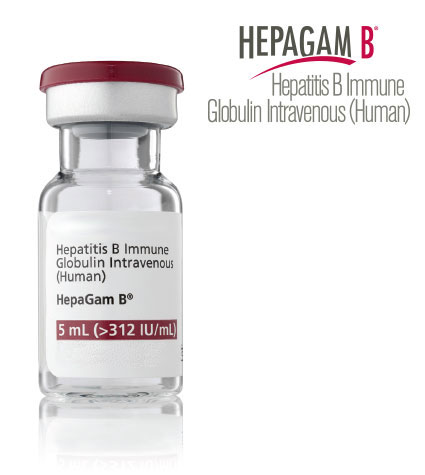
Defense against reinfection post-transplant and post-exposure prophylaxis1.
A hepatitis B immune globulin (HBIg) approved by the FDA to both prevent hepatitis B virus (HBV) recurrence following liver transplantation in HBsAg-positive patients and provide post-exposure prophylaxis1-3
Indications and Important Safety Information for HepaGam B®
Indications
HepaGam B® [Hepatitis B Immune Globulin Intravenous (Human)] is an intravenous immune globulin indicated for the following:
Prevention of Hepatitis B recurrence following liver transplant in HBsAg-positive liver transplant patients
Post-exposure prophylaxis including:
-
- Acute exposure to HBsAg-positive blood, plasma, or serum (parenteral exposure, direct mucus membrane contact, oral ingestion, etc.),
- Perinatal exposure of infants born to HBsAg-positive mothers,
- Sexual exposure to HBsAg-positive persons, and
- Household exposure to persons with acute HBV infection.
Important Safety Information
CONTRAINDICATIONS: Individuals known to have severe, potentially life-threatening reaction to human globulin preparations should not receive HepaGam B® or any other immune globulin (human). Individuals who are deficient in IgA may have the potential to develop IgA antibodies and have severe, potentially life-threatening allergic reactions.
For post-exposure prophylaxis indications, HepaGam B® must be administered intramuscularly only. In patients who have severe thrombocytopenia or any coagulation disorder that would contraindicate intramuscular injections, HepaGam B® should be given only if the expected benefits outweigh the potential risks.
WARNINGS and PRECAUTIONS: HepaGam B® [Hepatitis B Immune Globulin Intravenous (Human)] is a sterile solution of gamma globulin (IgG) made from human plasma. Products made from human plasma may carry a risk of transmitting infectious agents, eg, viruses and, theoretically, the Creutzfeldt-Jacob disease (CJD) agent.
Thrombotic events have been reported in association with the use of immune globulins. Patients at risk include those with a history of atherosclerosis, multiple cardiovascular risk factors, advanced age, impaired cardiac output, coagulation disorders, prolonged periods of immobilization, and/or known/suspected hyperviscosity.
The maltose contained in HepaGam B® can interfere with some types of blood glucose monitoring systems. Only testing systems that are glucose-specific should be used in patients receiving HepaGam B®. This interference can result in falsely elevated glucose readings that can lead to untreated hypoglycemia or to inappropriate insulin administration, resulting in life-threatening hypoglycemia.
Liver transplant patients should be monitored regularly for serum anti-HBs antibody levels.
Certain adverse drug reactions may be related to the rate of infusion. The recommended infusion rate must be closely followed. Patients must be closely monitored and carefully observed for any symptoms throughout the infusion period and immediately following an infusion.
The most common adverse drug reactions observed in clinical trial subjects were hypotension and nausea (2% of clinical trial subjects).
For product inquiries about HepaGam B®, call (866)-966-2655.
Please see full Prescribing Information for full prescribing details.
HepaGam B® [Hepatitis B Immune Globulin Intravenous (Human)] features:
Manufactured with high levels of anti-HBs1
Administered as an intravenous infusion (prevention of HBV recurrence following liver transplantation in HBsAg-positive patients) or intramuscular injection (post-exposure prophylaxis)1
Intravenous infusion for the prevention of HBV recurrence following liver transplantation in HBsAg-positive patients. May be administered in as few as 20 minutes.1*
Significant, clinically proven reduction in HBV recurrence and demonstrated survival benefit4
Two adverse reactions were observed in clinical trial subjects who received HepaGam B®—hypotension and nausea1
No thimerosol or mercury-derived preservatives1
SELECTED IMPORTANT SAFETY INFORMATION
Individuals known to have severe, potentially life-threatening reaction to human globulin preparations should not receive HepaGam B® or any other immune globulin (human). Individuals who are deficient in IgA may have the potential to develop IgA antibodies and have severe, potentially life-threatening allergic reactions.
*Based on a 20,000 IU dose with a total infusion volume of 35 mL at a rate of 2 mL per minute; volume of the dose will vary based on potency. The infusion rate should be decreased to 1 mL per minute or slower if the patient develops discomfort, infusion-related adverse events, or if there is concern about the speed of infusion.1

HepaGam B® [Hepatitis B Immune Globulin Intravenous (Human)] and all Kamada brand, product, service and feature names, logos, and slogans are trademarks or registered trademarks of Kamada in the United States and/or other countries. Copyright 2018 Kamada Pharmaceuticals. All rights reserved.